
Tirzah Behind The Story
T1 Behind the Story
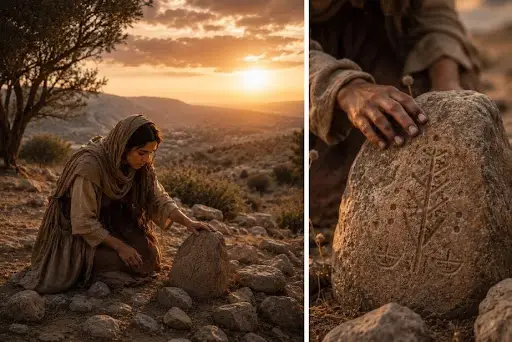
The Meeting Stones
One of the questions I asked while writing Tirzah was simple:
Where would a small village gather?
Readers familiar with the Old Testament often think immediately of the city gate. Scripture mentions the gate repeatedly because it served as the public center of many established towns and cities. Legal matters were heard there, elders met there, merchants gathered nearby, and important decisions were witnessed by the community.
But Tirzah isn’t a large city.
It is a small hill-country settlement during the days of the Judges, a time when many Israelite villages were little more than clusters of homes surrounded by fields, vineyards, and grazing land. Archaeology suggests that many villages of this period lacked the impressive gate complexes found in larger fortified cities.
Yet people still needed somewhere to gather.
They needed a place to discuss harvests, organize watchmen, settle disagreements, welcome travelers, and decide how the community would respond when danger threatened.
That is where the meeting stones were born.
Although Scripture doesn’t describe a village exactly like Tirzah, gathering around familiar landmarks would have been entirely natural. A well, a large tree, an open space, or a circle of well-known stones could easily become the heart of community life.
The meeting stones became one of my favorite settings to write because they quietly changed as the story unfolded.
Early in the novel, they are simply where neighbors meet. Children play nearby. News is exchanged. Everyday concerns are discussed.
As danger grows, those same stones take on greater significance. Decisions become heavier. Voices become more cautious. Leadership is tested. Fear and faith begin competing for the hearts of the people.
The stones themselves never change.
The people gathered around them do.
Perhaps that’s why I found myself returning there again and again while writing the novel. The meeting stones became a reminder that communities are shaped less by the places where they gather than by the character of the people who gather there.
Did You Know?
Throughout the Old Testament, important events often happened in public places where the community could witness them. In larger cities, that place was usually the gate. In smaller settlements like the fictional village of Tirzah, a familiar gathering place would have served much the same purpose.
Every story begins with history. Imagination simply helps us walk through it.
T2 Behind the Story
The Watch Fires
As I planned the village of Tirzah, I kept asking myself one question:
How would people know danger was coming?
Today, news reaches us instantly. A phone buzzes. A weather alert appears. A neighbor sends a text.
None of that existed during the days of the Judges.
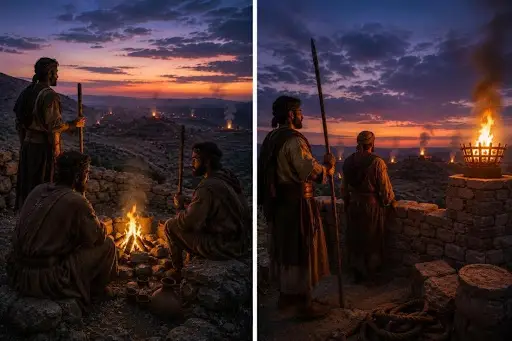
For the people of ancient Israel, the first warning often came from a watchman standing on a nearby ridge. From that vantage point, he could see farther than anyone in the village below. A distant dust cloud might mean traders were approaching. It might also mean raiders.
If danger threatened, every moment mattered.
Throughout history, people have used smoke by day and fire by night to communicate across long distances. While Scripture doesn’t describe an organized network of watch fires during the period of the Judges, it frequently speaks of watchmen keeping vigil over cities and settlements. In a land of rugged hills and scattered villages, fires on high places provide a historically reasonable way for neighboring communities to pass along urgent warnings.
That possibility became part of Tirzah.
The watch fires in the novel aren’t simply dramatic scenery. They represent a village learning to live with uncertainty. Every flame on the ridge reminds the people that peace is never something they can take for granted.
As I wrote those scenes, I realized the fires carried another meaning as well.
A watch fire only helps if someone is paying attention.
Someone must remain awake while others sleep. Someone must faithfully tend the fire. Someone must recognize the difference between an ordinary traveler and an approaching threat.
The villagers rarely notice those quiet acts of faithfulness.
Until the night they need them.
Did You Know?
High places served many purposes in the ancient world. They offered broad views of the surrounding countryside, making them ideal locations for watchmen. A fire burning on a ridge could be seen from miles away, especially after sunset.
Every story begins with history. Imagination simply helps us walk through it.
T3 Behind the Story
The Village Well
Readers often notice how many conversations in Tirzah happen at the well.
That wasn’t simply a convenient setting.
It was one of the busiest places in any ancient village.
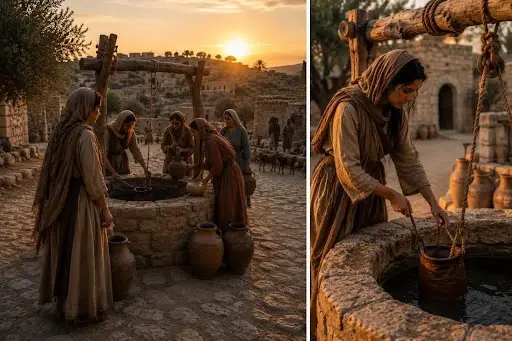
Water shaped every part of daily life. Before sunrise, women arrived carrying empty jars. Children helped fill smaller vessels. Shepherds watered their flocks. Travelers paused to rest before continuing their journey. News spread naturally because everyone eventually came to the well.
If you wanted to know what was happening in the village, you didn’t need an invitation.
You simply went to draw water.
The Bible reflects this reality again and again. Some of Scripture’s most memorable meetings take place beside wells. Abraham’s servant met Rebekah there. Jacob first saw Rachel at a well. Moses met Zipporah while defending her sisters at one. Wells were places where strangers became friends, families were formed, and lives changed.
As I wrote Tirzah, the well became more than a source of water.
It became the heartbeat of the village.
Characters who might never have visited one another’s homes naturally crossed paths there. Joy was shared. Concerns were voiced. Rumors traveled. Children laughed while parents exchanged stories of the day’s work.
The well reminded me that God often works through ordinary routines.
Some of life’s most significant moments don’t happen during extraordinary events.
They happen while we’re simply living faithfully from one day to the next.
Did You Know?
Digging a dependable well required enormous effort, making it one of a village’s most valuable possessions. Losing access to clean water could threaten the survival of an entire community, which explains why wells appear so often in the biblical narrative.
Every story begins with history. Imagination simply helps us walk through it.
T4 Behind the Story
The Storehouse
One building in Tirzah quietly influences nearly every family.
The storehouse.
Unlike the meeting stones or the village well, it isn’t a place where people naturally linger. Yet it represents something every community values.
Security.
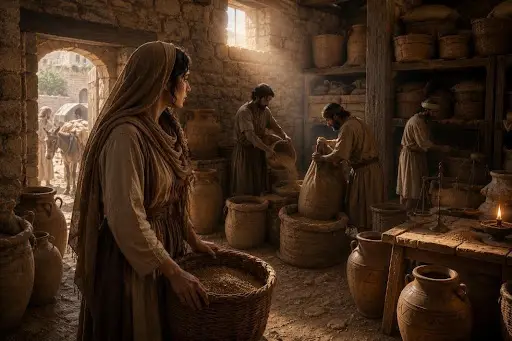
After harvest, grain had to last until the next growing season. Olive oil, dried figs, and other provisions were carefully stored and protected from moisture, pests, and thieves. A full storehouse gave families confidence that they could survive the months ahead.
An empty one invited worry.
As I researched village life during the Judges, I realized that a storehouse represented more than food.
It represented tomorrow.
Every basket of grain reflected months of labor in the fields. Every jar of oil spoke of olive trees patiently tended and fruit carefully pressed. The storehouse held the results of an entire year’s work.
That made it a natural setting for important conversations in Tirzah.
Whenever the villagers discussed their future, the storehouse quietly stood nearby as a reminder that wise decisions affected more than the present day. They shaped whether children would have enough to eat when winter came.
Perhaps that’s why I found myself returning to the storehouse throughout the novel.
It reminded me that hope often looks surprisingly ordinary.
Sometimes hope is simply a room filled with enough grain to face another season.
Did You Know?
Grain was commonly stored in large clay jars or specially prepared storage rooms designed to keep it dry and protect it from insects and rodents. Careful storage could mean the difference between survival and famine.
Every story begins with history. Imagination simply helps us walk through it.
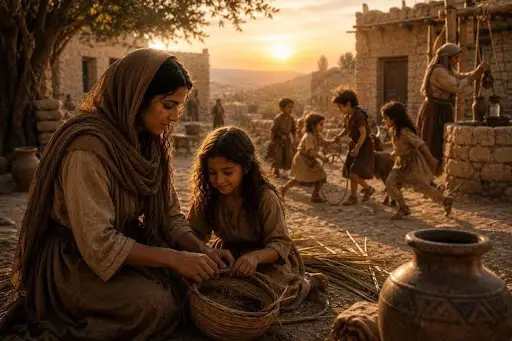
T5 Behind the Story
Tirzah, A New Generation
Readers sometimes ask if I always intended Tirzah to become the central character in the second novel.
The answer is yes.
Although Tirzah is her story, her journey really begins long before the opening chapter. Readers first meet her as a child born during Israel’s wilderness wanderings. She never felt the sting of an Egyptian taskmaster’s whip. She never molded bricks beneath the blazing Egyptian sun. She never walked between the towering walls of the sea.
Those memories belonged to her mother.
Yael’s generation witnessed God’s mighty acts of deliverance. They remembered the slavery, the plagues, the Passover, and the day the Lord led them out of Egypt. Their faith was shaped by what they had seen with their own eyes.
Tirzah’s generation inherited those stories.
That distinction fascinated me as I planned the second novel.
How does a child raised on stories of God’s faithfulness make that faith her own? What happens when the miracles belong to your parents’ memories instead of your own experience? How do you remain faithful when the generation that crossed the Red Sea begins to fade into history?
Those questions became the heart of Tirzah.
The Book of Judges describes a generation that eventually “did not know the Lord or the work that He had done for Israel” (Judges 2:10). Those words have always struck me as both heartbreaking and instructive. They remind us that faith cannot simply be inherited. Every generation must choose whether it will remember God’s faithfulness and walk in His ways.
Tirzah stands at that crossroads.
She deeply loves and respects the faith of those who came before her, especially her mother. Yet she cannot live on Yael’s experiences. She must learn to trust God amid the challenges of her own time, a time marked by uncertainty, tribal conflict, and the spiritual instability that characterized the days of the Judges.
As I wrote her story, I wanted readers to see more than the continuation of one family’s journey. I wanted them to witness the passing of a spiritual legacy.
Parents can tell the stories.
They can model faithfulness.
They can point their children toward God.
But eventually every son and daughter must answer the same question for themselves.
Will I trust Him, too?
That question belongs to every generation.
It belonged to Tirzah.
It belongs to us.
Did You Know?
Throughout the Old Testament, God often works through generations rather than individuals alone. The stories of Abraham and Isaac, Moses and Joshua, Naomi and Ruth all remind us that God’s covenant faithfulness extends beyond one lifetime. Each generation receives the testimony of those who came before and is called to live faithfully in its own day.
Every story begins with history. Imagination simply helps us walk through it.